The Wonders of Village Cricket
White flannels, a church spire, tea at four o'clock and a leg-side boundary into the nettles. Village cricket is England at its most itself — and it matters more than ever.
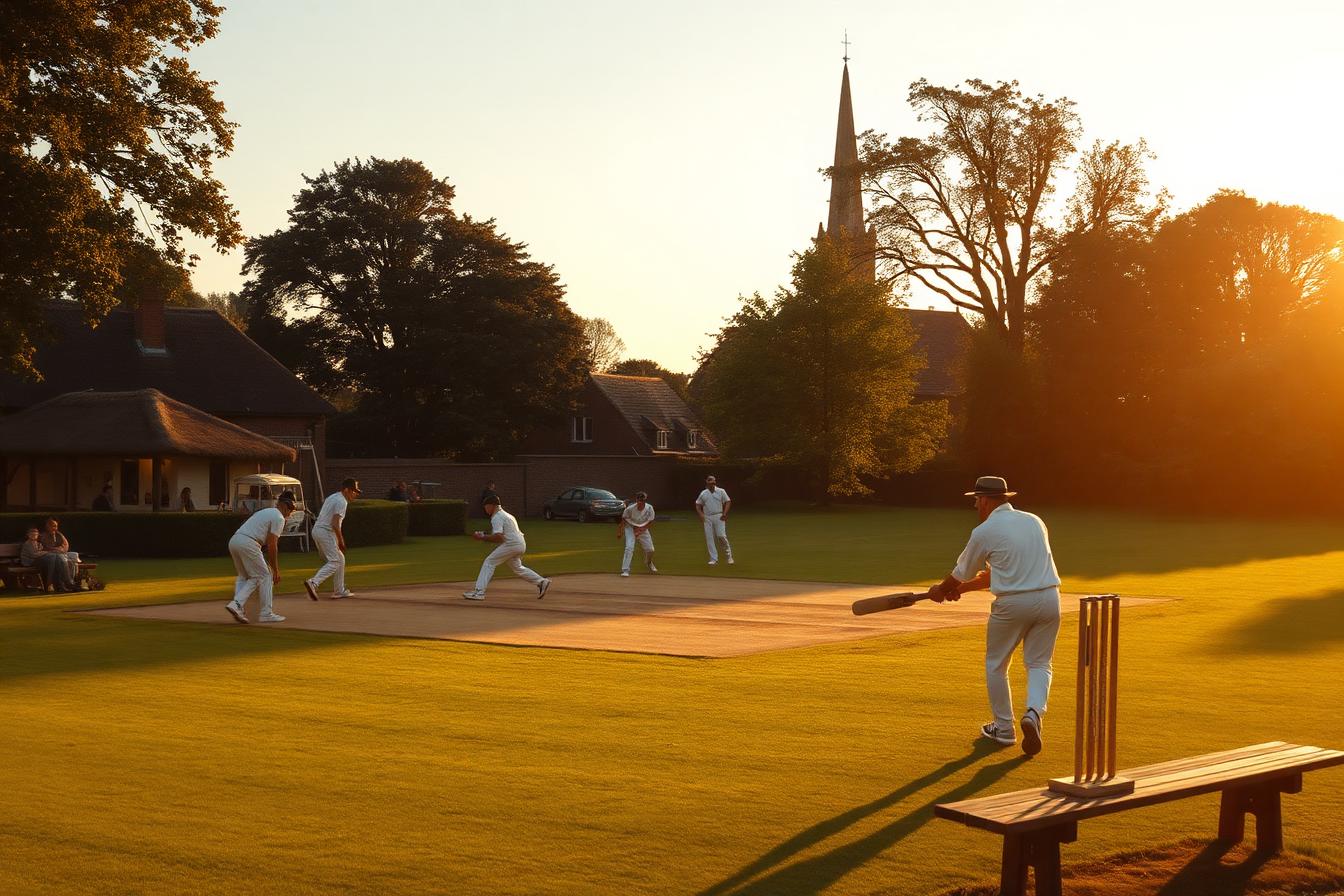
There is a sound that belongs to the English summer more completely than any other: the small, dry knock of a cricket ball meeting the middle of a bat, arriving half a second after you see it, across a field at the end of a village. Add a church clock, a scorer with a pencil, a dog asleep by the boundary rope, and you have village cricket — a institution so deeply woven into the national fabric that we risk forgetting how extraordinary it is. Almost nowhere else on earth does elite-level tradition survive at grass roots in quite this way, on quite this many Saturday afternoons, in quite this many villages.
The game's roots in the countryside are ancient. Cricket was a rural pastime long before it was an urban spectacle, played on sheep-grazed downland and common land across the south of England, with the bat itself descended from a shepherd's crook. The great Hambledon club of the eighteenth century — a village team, on a Hampshire down — effectively wrote the laws of the game while the MCC was still finding its feet. Village cricket is not a small version of the real thing. By any honest reading of history, it is the original.
What makes it wonderful, though, is not history but character. A village side is a cross-section of nowhere else in modern life. The opening bowler is a farmer of fifty-three who has opened the bowling since the Major administration. The number four is a sixth-former home from university, all elbows and promise. The wicketkeeper is the landlord of the pub the team is named after, and the umpire is a retired headmaster whose decisions are accepted with a reverence no VAR will ever command. On a cricket field the village's social hierarchy dissolves into a simpler meritocracy: can you bowl straight, and will you field at fine leg in the cold without complaining?
The rituals are load-bearing. The teas — sandwiches, cake, a urn of tea strong enough to stand a bat in — prepared by a rotation of hands and eaten at long tables, are not an interruption of the match. They are the point of it, as much as any cover drive. The scorer's hut, the sightscreen that somebody has to heave round at each change of ends, the ancient roller, the pavilion with photographs of teams from 1932 in which every face is a local surname you still hear at the post office. Village cricket is a village remembering itself, weekly.
I will not pretend all is well, because it is not, and anyone who loves the game should say so plainly. Player numbers have been under pressure for years. Villages have changed: commutes lengthen, Sunday trading took the weekend's shape away, young men are pulled by a hundred screens and the easy Sunday lie-in, and sides that once ran three XIs now struggle to raise one. Clubs fold, grounds are sold, fixtures go unfulfilled. Each lost club is a small tear in the fabric that no leisure centre replaces.
And yet the game adapts, because it always has. Evening cricket — twenty overs after work, a format the village game essentially invented for modern life — has brought in players who cannot give a whole Saturday. Women's and girls' sections are the fastest-growing part of the grass-roots game, and clubs that embraced them early have discovered not a concession but a revival. All-Stars programmes put bats in the hands of five-year-olds on the same outfields where their great-grandparents fielded. The villages that treat the club as a living institution rather than a museum are finding that the appetite never went away; it only needed a new invitation.
There is a larger point here, beyond sport. A village cricket club is one of the last places where a community does something difficult, together, for no profit, across generations, in public. It teaches children that adults keep score honestly, that the umpire's word is final, that you applaud the opposition's good shot, and that losing with grace is a skill and not a humiliation. A country that can still do that on a thousand village greens every summer weekend has not lost as much as it sometimes fears.
So if you pass a ground this summer and see the whites out and the rope down, do what the game invites: stop the car, sit on the bench, watch an over or three. Nobody will ask who you are. Somebody will tell you the score. And if you stay until the light goes soft over the pavilion, you may find, as generations have, that you have stumbled into the best of England, quietly carrying on.