Why Solar Panels Are an Ecological Problem We Are Refusing to Discuss
Clean at the point of use is not the same as clean. The mining, manufacturing, land use and waste realities behind solar deserve an honest hearing.
Let me be clear at the outset: I am not against renewable energy, and I am not arguing that fossil fuels are preferable. I am arguing that a technology sold as environmentally faultless should be able to withstand scrutiny, and that solar photovoltaics currently receive far less of it than they deserve.
The claim that a solar panel is clean rests almost entirely on what happens at one stage of its life — the twenty-five years it sits producing electricity without emissions. That stage is genuinely excellent. The problem is the stages either side of it, which are treated as somebody else's accounting.
The manufacturing is not clean. Polysilicon production is extraordinarily energy-intensive, requiring the reduction of quartz at around 1,800 degrees. The majority of the world's supply is made in regions where that heat comes overwhelmingly from coal. So a panel begins its life carrying a substantial carbon debt, paid in the very fuel it is meant to displace. The debt is usually repaid within a few years of operation, which is the standard defence, but describing the product as zero-carbon is simply inaccurate.
The chemistry is unpleasant. Panel manufacturing involves silane, hydrofluoric acid, nitrogen trifluoride and, in thin-film variants, cadmium telluride. Nitrogen trifluoride is a greenhouse gas thousands of times more potent than carbon dioxide. Handled well, these are manageable industrial risks. Handled badly, in jurisdictions with light regulation and heavy production targets, they are not, and we import the finished product without importing responsibility for how it was made.
The mining is real. Silver, copper, aluminium, silicon, and for the batteries that make solar useful after dark, lithium, cobalt and nickel. These come from open-pit mines, brine extraction that draws heavily on water in arid regions, and supply chains with documented labour problems. A rooftop in Kent is quiet and unobtrusive; the extraction that produced it is neither.
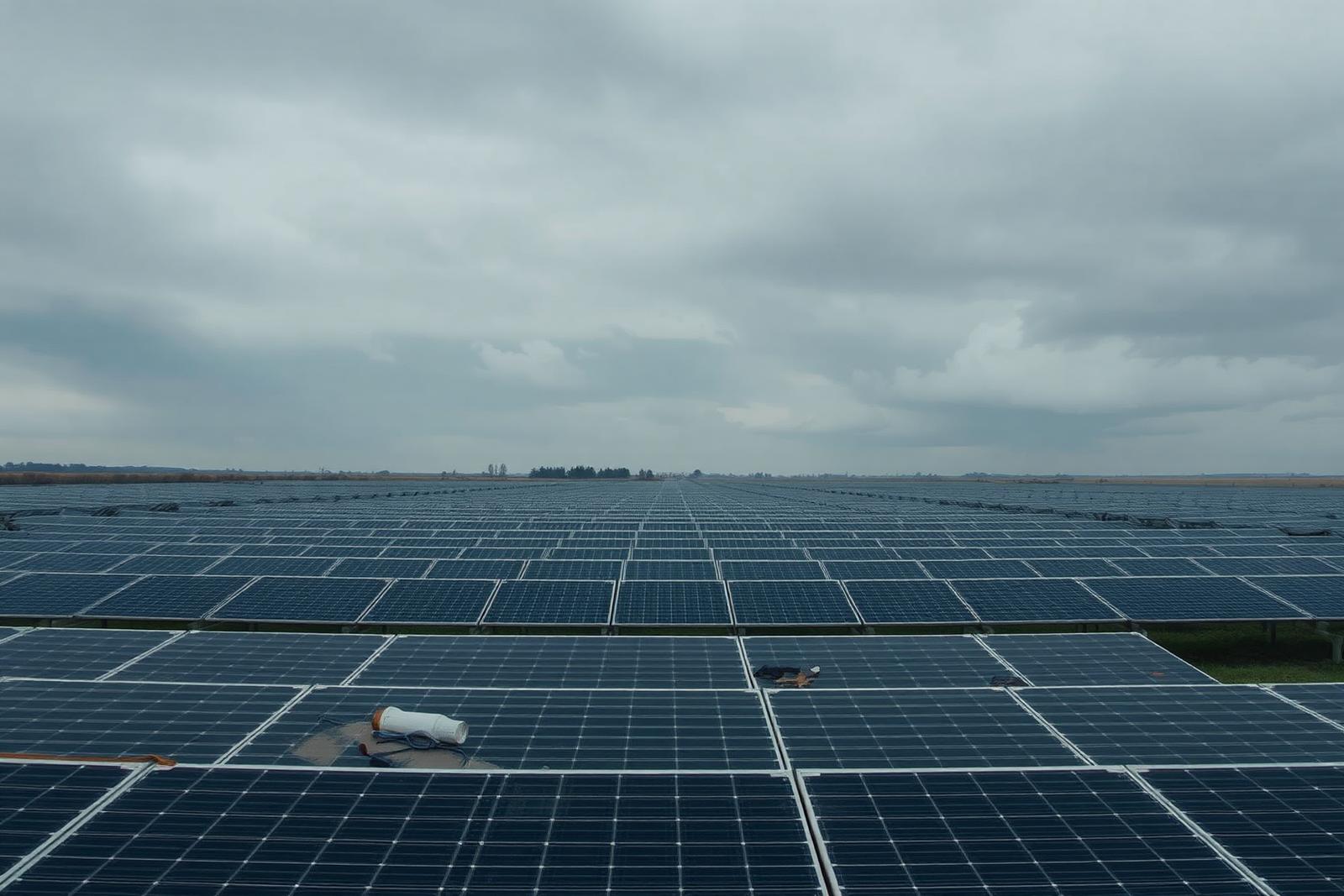
The land use question is the one people find hardest. Solar has a low energy density, so utility-scale generation requires a great deal of surface area. In Britain that increasingly means productive agricultural land, because flat, south-facing, grid-connected fields are exactly what farming also wants. Covering food-producing land in glass and steel to generate intermittent electricity, while importing more food, is not obviously an environmental gain. Rooftops, car parks, brownfield and industrial sheds are a different matter entirely, and we use far too few of them.
Then there is the end of life, which is the genuine scandal. Panels are laminated composites — glass bonded to polymer, silicon, silver contacts and an aluminium frame. That construction is superb for surviving weather and dreadful for recycling. Separating the materials economically is difficult, so the overwhelming majority of decommissioned panels are landfilled or shipped abroad. The first great wave of installations is now reaching retirement, and the volume of waste arriving over the next two decades runs into tens of millions of tonnes globally. Recycling capacity is nowhere close.
And the intermittency has a hidden footprint. Solar produces most where it is needed least — the middle of a summer day — and nothing on a December evening. Bridging that gap requires either grid-scale battery storage, with its own mining and fire-risk profile, or gas plant held in reserve and run inefficiently. Neither is included when a panel's environmental credentials are advertised.
None of this makes solar worthless. On a factory roof in Andalusia, feeding a load that peaks with the sun, it is an outstanding technology. My objection is to the framing, and the framing has consequences: it produces subsidy regimes that reward installed capacity rather than lifecycle outcomes, and it discourages the unglamorous work that would actually help.
That work is not mysterious. Manufacture where the grid is clean. Mandate producer responsibility so the maker owns the panel at end of life. Fund recycling technology properly rather than assuming it will appear. Prioritise roofs and hard standing over farmland. Publish honest full-lifecycle figures instead of point-of-use ones.
Every energy technology has a cost. Hydroelectricity floods valleys, wind kills birds and consumes concrete, nuclear leaves waste, gas emits. Mature policy weighs those costs against each other openly. Treating one option as beyond criticism is not environmentalism. It is marketing, and the environment does not benefit from marketing.