The Grave of Genghis Khan: Where Is the Great Khan Buried?
Eight centuries on, the most powerful conqueror in history has no known grave. The theories, the evidence and the reason Mongolia may not want him found.
Genghis Khan died in August 1227, somewhere in the campaign against the Western Xia. Within fifty years his descendants ruled the largest contiguous land empire the world has ever known, from the Sea of Japan to the Danube. And yet nobody knows where he is buried. Not approximately. Not within a hundred miles. It is one of the great unresolved locations in human history.
The concealment was deliberate and thorough. The Mongol funerary tradition for a great khan required secrecy, and the accounts that survive describe measures that would satisfy a modern intelligence service. Marco Polo, writing decades later, claimed the escort killed everyone they encountered on the journey to the burial site. Later Persian and Chinese sources describe the soldiers who dug the grave being executed, and the executioners in turn being killed. A thousand horses were said to have been driven over the ground to erase it, and trees planted, or a river diverted across it.
Some of this is certainly embroidery. The Mongols were not shy about their achievements, but they were genuinely serious about this particular silence, and the reason is theological rather than military. In the shamanic tradition of the steppe, disturbing the resting place of a great spirit invites catastrophe. Concealment was protection, not modesty.
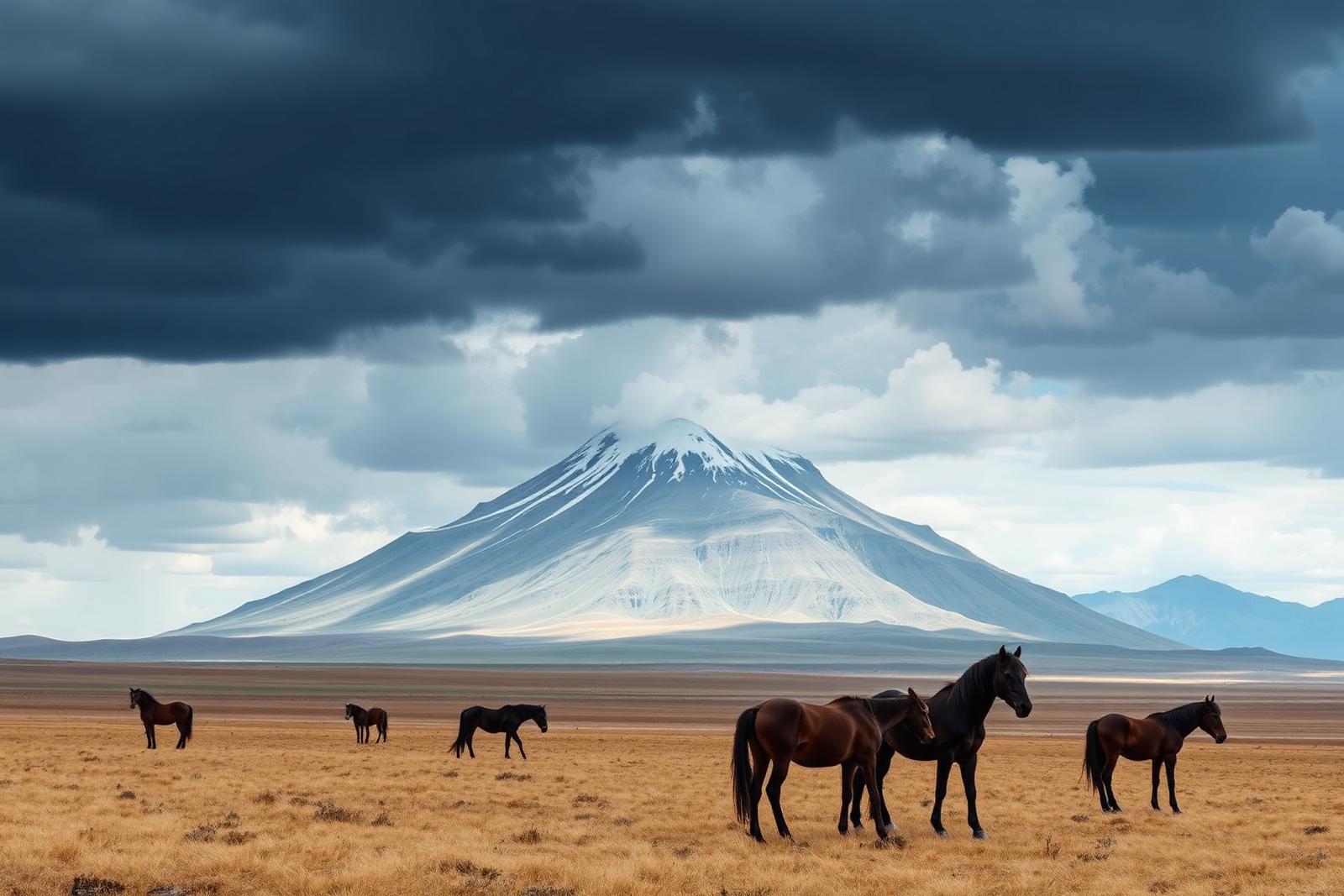
The strongest candidate location is Burkhan Khaldun, a mountain in the Khentii range in north-eastern Mongolia. The Secret History of the Mongols — the oldest surviving Mongolian text and the closest thing we have to a primary account — records that Temüjin, as he then was, hid on that mountain as a young man while enemies hunted him, and swore afterwards to honour it every day of his life. It was already sacred, and the sources associate his burial with the Ikh Khorig, the Great Taboo: a vast forbidden zone around the mountain, sealed off and patrolled for centuries by a hereditary tribe of guards known as the Darkhad.
That prohibition held remarkably well. The zone remained restricted through the Qing period and then, for different reasons, under Soviet influence in the twentieth century, when the area was designated a restricted region and much of the surrounding archaeology went unexamined. Burkhan Khaldun is now a UNESCO World Heritage site, which protects it further.
The rival theories are less convincing but persistent. Some point to the Ordos region of Inner Mongolia in China, where the Mausoleum of Genghis Khan stands — an impressive complex that is explicitly a shrine, not a grave, containing relics rather than remains. Others suggest the Altai mountains, on the grounds that he died on campaign in the west and the body may not have been carried the full distance home. A persistent story, repeated widely and evidenced nowhere, holds that the Onon river was dammed and rerouted over the tomb.
Modern searching has been surprisingly sophisticated and surprisingly unsuccessful. A Japanese-Mongolian expedition surveyed extensively in the 1990s. Dr Albert Yu-Min Lin of the University of California ran the Valley of the Khans project, using satellite imagery analysed by more than ten thousand online volunteers who examined the terrain remotely for anomalies, followed by non-invasive ground-penetrating radar and magnetometry. The approach was chosen precisely to avoid digging. It found archaeological sites of real interest. It did not find him.
There is also a strong argument that nothing dramatic remains to be found. Mongol burials of the period were not pyramids. A khan might be interred in a wooden coffin or simply wrapped, with horses, weapons and personal goods, in a grave deliberately levelled and left unmarked. After eight centuries beneath forest and grassland, the archaeological signature could be almost nothing — a scatter of metal and bone in an area the size of Wales.
And then there is the question of whether he should be found at all. Many Mongolians, including a good number of archaeologists, are firmly against the search. Genghis Khan is not a distant curiosity there; he is the founder of the nation, and the taboo against disturbing him is a living belief rather than a historical footnote. Excavating him to satisfy foreign curiosity strikes a great many people as a desecration.
I find something fitting in that. A man who conquered a quarter of the world lies somewhere under grass that looks exactly like all the other grass, guarded first by soldiers, then by superstition, and now by the quiet consent of the people who claim him. Whatever else the Mongols achieved, they kept one secret perfectly.